


I remember exactly when I built the tool chest because I remember who I was then.
I was working at Sears Trostel Lumber, confident in a way I didn’t yet know how to protect. My supervisor, Jim, a master woodworker and millworker, wore suspenders every day. After a while, I started wearing them too—not as a uniform, exactly, but as a way of aligning myself with the work and seeing myself through his expertise. He never questioned whether I belonged there. He just showed me how things worked—how rough lumber moved through machines, how grain mattered, how patience mattered more.
I didn’t have much formal experience yet, but I trusted my ability to learn. I had dropped out of college not long before—restless, searching, but needing something solid beneath my hands. I may have overstated my abilities to get the job, but I stayed late to earn them. After my shift ended, I practiced often, eager to use the woodshop’s vast assortment of professional tools and machinery. It felt like a playground to me. I wandered among the stacked lumber rising into the rafters, running my hands along the boards, noticing their textures, their colors, their oddities. I learned the subtle differences by smell alone—the sweetness of pine, the heavier, almost spicy scent of hardwoods. I ruined pieces of wood regularly and started again without much concern. The learning was the point. The space itself invited attention, curiosity, and time.
The mill was a world of its own—a factory for wood. Rough boards moved through it methodically, emerging as S4S—surfaced on four sides—clean and square after passing through planers and jointers. Some pieces went further, into the molder, a massive machine with multiple heads, each responsible for shaping a different part of the profile. The wood entered plain and unassuming and came out transformed—casing, crown, base—its new purpose decided by the last pass it made.
There was always scrap—often long drops or discarded pieces from the milling process. We were allowed to use that wood for our own projects, and I did. I especially loved maple, the way its light color and subtle figure held quiet movement, never shouting. I glued the scraps together into panels, butcher-block style, knowing they would never be perfect, knowing I would see every seam. That kind of construction was common for cutting boards, but using it for a cabinet felt like something new—improvised, resourceful, and entirely my own.
That was the wood I used for the tool chest.
One of the biggest challenges when I built the cabinet was learning how to cut box joints. At the time, they felt almost ceremonial, like praying hands—the repeating fingers locking two boards together through rhythm and repetition. Box joints have been around a long time. They emerged out of necessity: a straightforward solution for chests, drawers, and boxes that needed to endure real use. They’re often described as a cousin to dovetails—less ornate, more direct—and I think that’s why I was drawn to them. There’s something honest about a joint that doesn’t try to impress, only to hold and remain consistent.
Mine weren’t clean. Some fingers fit tightly, others less so. But when I dry-fit the pieces and felt them lock together, I understood something important. Strength, I learned, wasn’t about elegance. It was about endurance. And in that moment, that was enough.
When it was done, I didn’t see it as beautiful. I saw it as proof—proof that I could build something useful, solid, respectable.
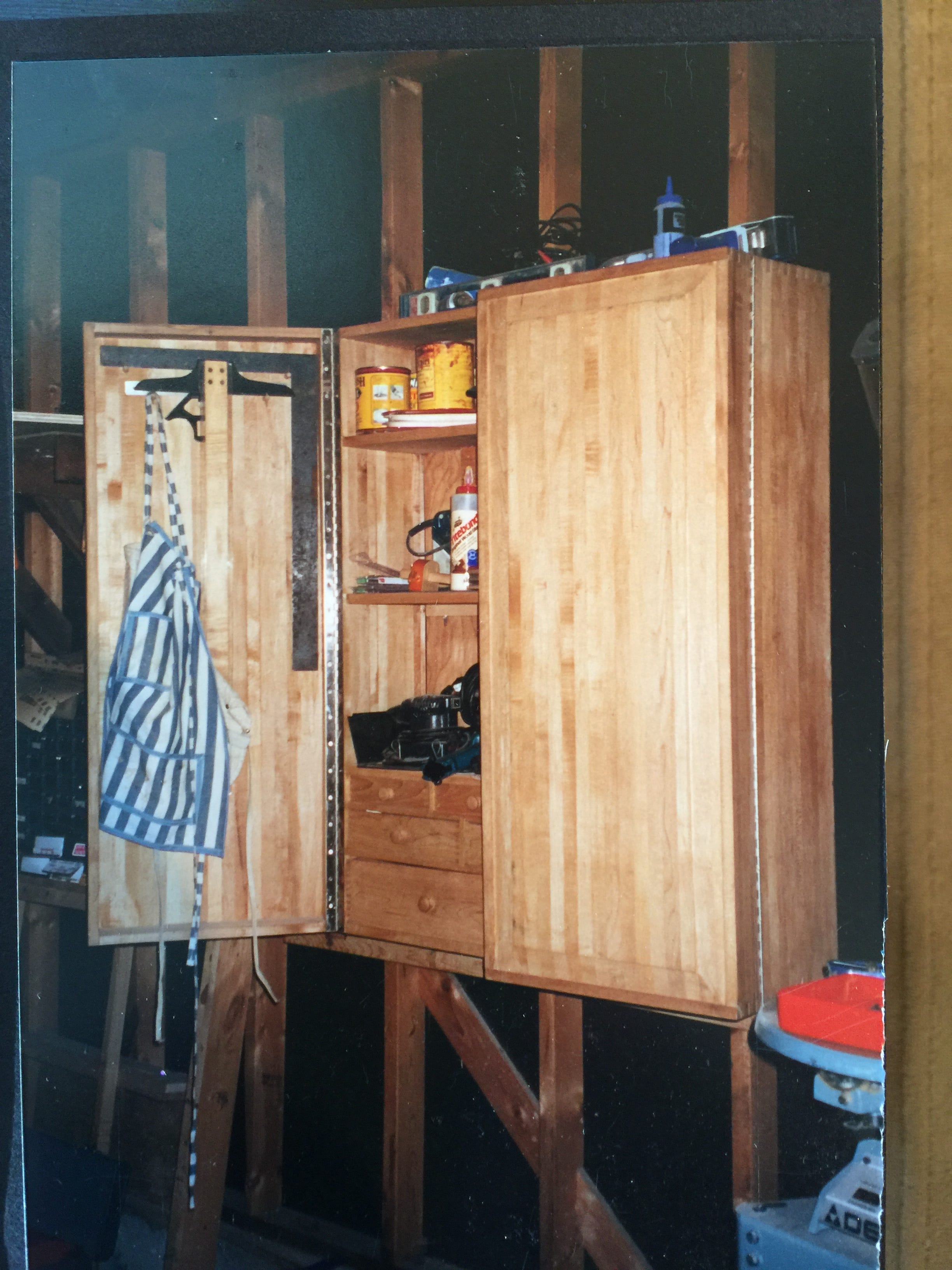
It followed me through the various spaces of my life. From the earliest days in a small shed with a dirt floor to my current shop—the one that took nearly everything I had to imagine and build with my own hands. The dreaming, the planning, the effort required to bring it into being exhausted us both. When that shop was finally finished, it went quiet. So did I. We were both waiting for the right moment to move forward again.


Looking back now, I can see how much of my life was built this way—functional, durable, designed to survive. I learned to inhabit forms that worked well enough, even when they didn’t fit particularly well. I stayed useful. I stayed employed. I stayed steady.
Somewhere along the way, the cabinet stopped giving me what I needed. I didn’t need space for hand planes and chisels, or room for the tools of a fine master craftsman—a role I once thought I was meant to grow into, even though it never quite fit.
The proving went on longer than it should have. Eventually, the cabinet became something like a stump—spent, no longer wrong, but no longer right either. I had grown into something different. It had given what it could.
A few weeks ago, standing in my office, I realized I needed a bookshelf. I didn’t want to buy one. I wanted to make do with what I already had. I’ve learned, over time, to hesitate before purchasing something when I know I can build it myself—but there is always a quiet negotiation between how much time I have and how much I want the thing finished. Repurposing lives in that tension. It allows something old and tired to be reconsidered, not rushed, and brought back into use without starting over.
I walked into my shop and let my eyes move slowly, not searching so much as listening. When they landed on the cabinet, the answer arrived all at once.
If I could stop seeing it as what it had been, I could finally see what it was capable of now.
The work itself was quiet. Sanding. Filling old hinge holes. Prepping surfaces. The orbital sander hummed steadily in circles across wood that had collected years of shop grime. Fine dust hung in the afternoon light. I’ve never been interested in perfect finishes. I like edges softened by use, surfaces that show where they’ve been. I added a simple base, stained black, to lift the cabinet and ground it visually. The old screw holes from the piano hinges got filled with wood filler tinted darker—not to hide them, but to let them show up honestly. You can still see them if you look closely.
When I stepped back, it wasn’t a tool chest anymore. But it wasn’t pretending to be something else, either.
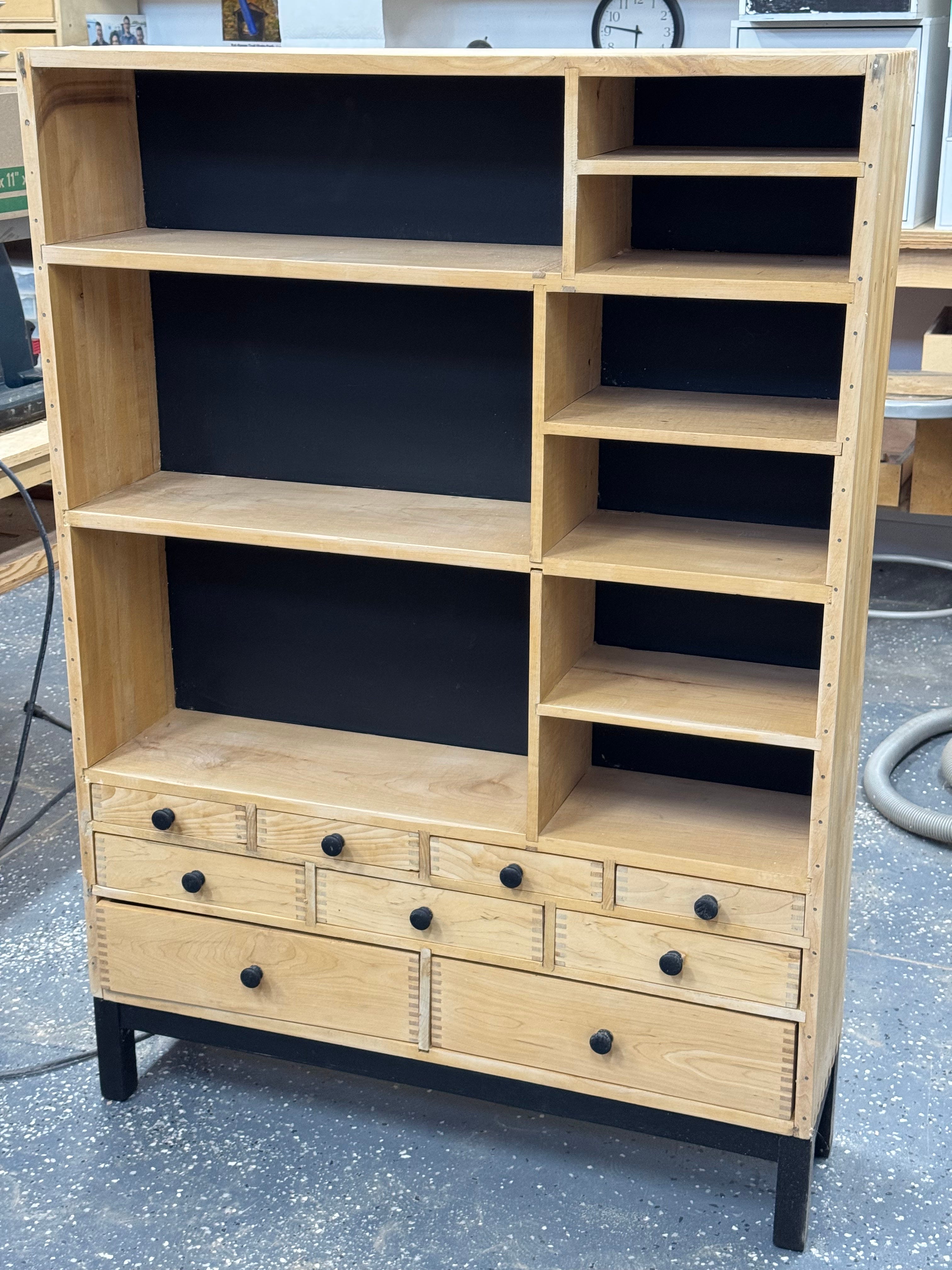


It had simply been allowed to change function.
For years, I lived inside forms I thought I was supposed to inhabit. When I moved to Colorado at sixteen, I assumed I should ski. I endured the stiff boots, the long rental process, the slow, precarious drives on icy mountain roads, and the crowded slopes. I followed the form because it seemed required, even though my body never felt at home in it.
I often think of a boy I knew in high school—a photographer who stood apart without apology. He moved through the halls with a camera always around his neck, dressed more like an adventurer than a student trying to keep up. I admired him and feared him in equal measure. I wanted that kind of authenticity, but not the isolation that seemed to accompany it. So I adapted. I learned to fit. I learned to survive.
The cabinet didn’t fail at being a tool chest. It simply outlived that purpose. It didn’t need to be discarded. It needed to be reconsidered.
I don’t feel finished. I don’t feel perfected. I feel more willing now—to listen for function instead of forcing form, to allow usefulness to change, to trust that what once helped me survive doesn’t have to determine what comes next.
I’m still building.
I’m just learning that permission can be as structural as necessity.
“Try to love the questions themselves…
and live the questions now.”— Rainer Maria Rilke
You are such an eloquent writer Victoria. I love your "new" bookcase!