


I wish I still had my journals from my youth. I don’t—I destroyed them years ago in a moment I regret. But I can still see that evening clearly, like a photograph:
Friday, August 8, 1980
The afternoon air was hot and heavy, thick enough to stop me in my tracks. But I have an idea: I’m going to start running. Someday I’ll be on the track team. I might even wear a Marlington school jacket.
I wasn’t sure what to wear for a run. Nothing seemed right. I set out with sneakers with tube socks, shorts, and a t-shirt. I ran on the shoulder of the street. There weren’t many cars, but when they passed me, I moved farther into the gravel. After a minute, I was gasping for air. My chest hurt. My legs hurt. I stopped, but it felt like cheating, so I tried to keep going. I didn’t want to give up. But it was no use.
I can’t do it. I feel fat and stupid and awkward. Weak. I thought I could do this. Join the track team. I want to cry. This is not for me.
A Letter to My Younger Self
Hey girl,
You didn’t fail. You didn’t know.
James Clear writes in Atomic Habits that we vastly overestimate what we can accomplish in a single day and underestimate what we can achieve through small, consistent actions over time. You wanted instant results like fast food. But every run begins with a walk.
What you really needed was to start small. To be okay with that for a while.
I forgive you. Not because you committed some heinous crime, but because, as Daniel Pink points out in The Power of Regret, dwelling on past failures leads to depression unless we use them to make different choices now. And we’ve been there enough times.
So here’s what I know now: there are no shortcuts for the things that matter most. But the work doesn’t have to be drudgery.
The Pattern Repeats
There was a time when I ran every day to train for a half-marathon. Thirteen miles. I ran several times a week, sometimes covering six miles in a day, thinking it would be enough.
It wasn’t.
On race day, Pam and I were practically the last to cross the finish line. We weren’t even running, but it was more of a speed walk. At the end of the race, we collapsed like those athletes you see during the Olympics who have entirely spent every ounce of energy in their bodies. Except we weren’t the same caliber of athletes—they with their sinewy bodies of a long-distance runner and us lying in a puddle of flabby flesh. After this race, I stopped running again.
I was running for the wrong reason. To finish a race? So what? Not substantial enough for me.
This would have been excellent self-care—to be a runner. But the truth is, it’s hard. It requires consistency and discipline. Both of which I still struggle with.
So what’s the answer?
Five Years Ago: The Breaking Point
My world was falling apart in 2020. COVID seemed so small compared to my internal pressures.
The most profound changes seem to occur at the tipping point of a massive breakdown, when you’re backed against the wall. In desperation, I’ve made some interesting choices.
Five years ago, I laced up my running shoes—the ones with the Nike emblem taunting me to “just do it.” As Seth Godin points out, “just do it” is not helpful advice. It can be misinterpreted as: “Do what you can get away with” or even “Come on already.” A more useful word choice would have been ‘merely do it.’ What he meant was to stay focused on your intentions or the change you wish to make.
In that moment of crisis, I not only questioned my intentions but also my purpose and everything else in the world. Without even creating a plan to walk, I found myself heading out to get away from the noise, confusion, and chaos. I felt like I might never come back. It was an unconscious reaction.
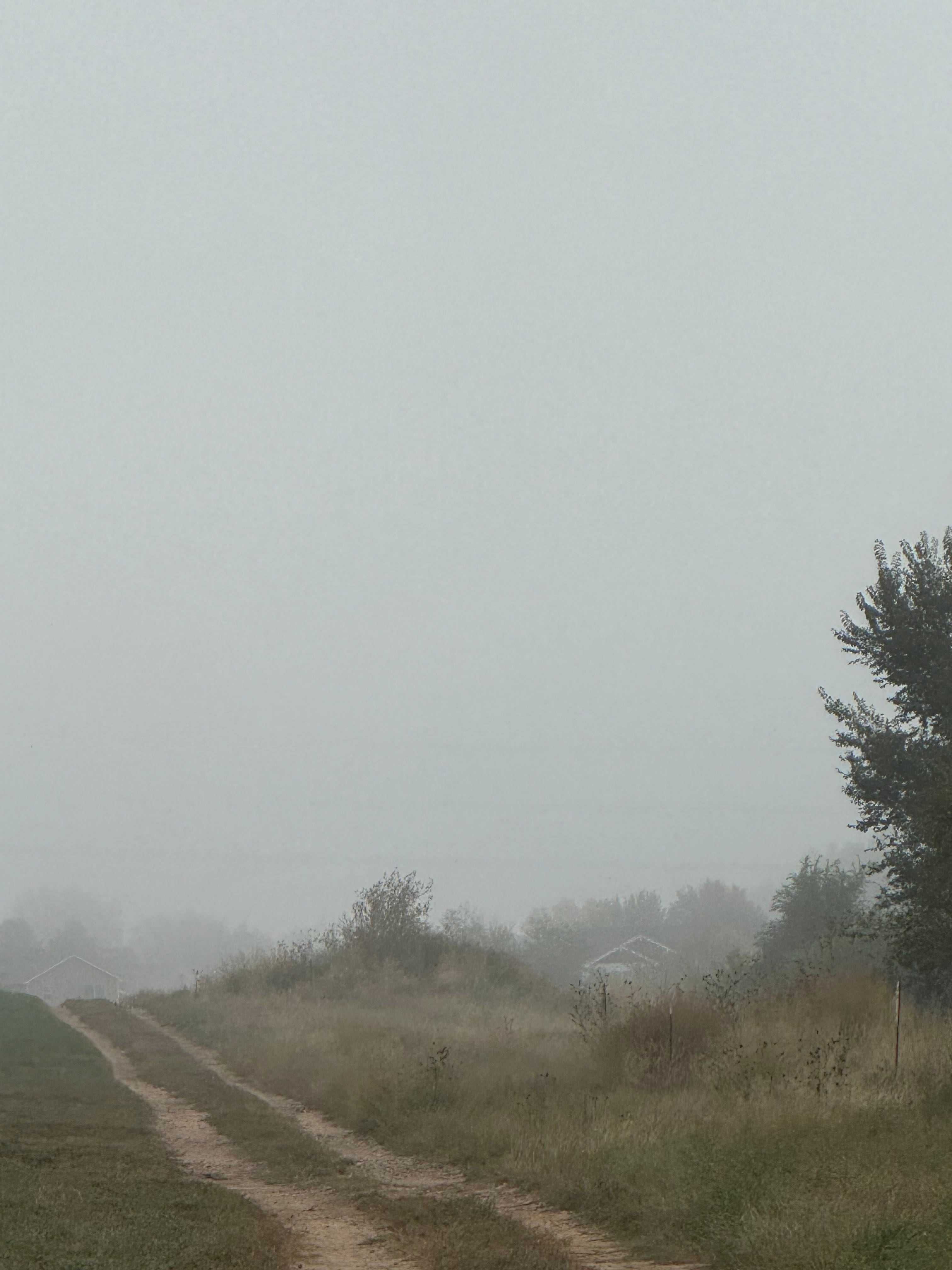
No playlist. No fitness tracker. Just the low hum of panic and a deep need to get out of my own head.
A single lap around the block turned into two laps, then a route through the neighborhood. There was a deep, nurturing respite in letting my feet connect with the earth in a steady pulse that eased the burden of my heavy heart.
The results were profound and immediate. And I kept doing it.
The Flight Response
In the 1994 film Forrest Gump, there’s a point when Forrest says, “That day, for no particular reason, I decided to go for a little run.” He starts running down his driveway, across town, across Alabama—and keeps going until he eventually runs across the entire U.S. multiple times.
There’s something about that inability to stop. The escape lingered in my mind for years after that movie. Later, Dory the fish would sing, “Just keep swimming.” My mind would urge me, “Just keep walking or swimming.” Both work.
Most people interpreted these as metaphors for perseverance. I took them literally. I started swimming or walking—every damn day.
Like Forrest, I didn’t plan it. One day, the pressure became overwhelming, and my own flight response kicked in. I just needed to move. I needed space. I needed quiet.
At the time, my life felt like a pressure cooker. My own mental health battles, an adult daughter fighting her own demons, and my granddaughter—our sweet, complex girl with autism, Tourette’s, anxiety, and PDA (pathological demand avoidance)—all under my roof. Add the everyday stress of finances, career, and health, and I was on the edge of spontaneous combustion.
The Neuroscience of Survival: Fight, Flight, Freeze, Faint
When stress hits hard, our nervous systems go into a primitive state. The amygdala—that almond-shaped cluster of neurons deep in the brain—acts as our internal smoke detector. It constantly scans for threats, operating far below conscious awareness.
When the amygdala perceives danger (real or imagined), it triggers the hypothalamic-pituitary-adrenal (HPA) axis. Within milliseconds, stress hormones flood the body. Cortisol. Adrenaline. The sympathetic nervous system activates, and the body prepares for survival.
This happens in the limbic system—the ancient, emotional brain—seconds before the prefrontal cortex (our logical, reasoning brain) can even register what’s happening. We don’t choose these responses. They choose us.
Four responses emerge:
Fight (snapping at whoever’s nearby)
Flight (walking, running, escaping)
Freeze (binging Netflix until our souls leave our bodies)
Fawn (people-pleasing and appeasing to avoid conflict)
I used to think these were dramatic metaphors. They’re literal physiological responses, hardwired into our neurobiology.
My body wasn’t betraying me. It was trying to save me.
Here’s what’s fascinating: walking activates the parasympathetic nervous system—the “rest and digest” counterbalance to the fight-or-flight response. The rhythmic, bilateral movement (left foot, right foot, left foot, right foot) helps regulate the nervous system. This same bilateral stimulation is used in EMDR therapy to process trauma.
Walking literally calms the brain.
So I walked. No need to run or run away from anything. All I needed was a first step and the desire to take one more. I had no expectations from myself or anyone else.
The Sunrise Walk
I started calling it my sunrise walk. Libby DeLana calls it the Morning Walk in her book Do Walk.
“We walk not to escape life but to find it,” she writes.
I woke at 4 a.m. without an alarm and waited for the light. When the sun finally pushed away from the horizon, I’d head out—often overdressed and borrowing from my grandmother’s habit of carrying everything but the kitchen sink in her purse. I overprepare too. It soothes me.
At first, I’d go for fifteen minutes, then I’d be surprised when I didn’t want to turn around. I was enjoying the quiet. The solitude. The freedom. One mile turned into two, then three, about an hour out of my day. On harder days, I give myself the time and space to walk five or six miles.
Somewhere along the way, it fundamentally changed my life.
The apparent benefits came first. My anxiety eased. My thoughts got quieter. There were unexpected disappointments too—my jeans didn’t get looser (turns out, walking increases appetite. How rude).
But the real magic wasn’t physical at all.
It was spiritual.
My Walking Companions
It didn’t take long for me to connect the walking with the other thing I truly love—reading. Going for a walk with my mentors felt so comforting and inspiring. Audible became my joy.
I couldn’t sit still to read, but I could walk and listen to my favorite mentors: Martha Beck, Seth Godin, Maryanne Wolf, Anne Lamott, and Steven Pressfield. They became my early morning teachers.
It felt indulgent—like intellectual cardio. My footsteps matched the rhythm of ideas. It was my moving classroom, my morning church, my metronome of sanity.
When the Books Went Quiet
Then one morning, mid-stride, I realized I hadn’t heard a word of the book for twenty minutes.
The voice in my earbuds faded, replaced by something quieter and more authentic. It wasn’t Audible. It was a voice —or a knowing —inside me.
Or maybe it wasn’t inside me at all. Perhaps it was beside me.
I don’t know how else to describe it except to say: I wasn’t alone anymore.
Ideas came flooding in—whole paragraphs and sentences that glowed. But they didn’t feel like my ideas. They felt like answers to questions I hadn’t yet asked. Comfort for sorrows I hadn’t yet spoken. Wisdom I didn’t possess on my own.
My head felt swimmy and giddy, like carbonated bubbles rising from a glass of champagne. But my heart—my heart felt held.
This is what people mean when they talk about meditation or prayer. Not the formal, structured kind. The walking kind. The listening kind.
I started carrying a notebook to catch the words before they evaporated. Words that felt like gifts. Like someone was walking with me, speaking in a voice I recognized but couldn’t name.
The same message came every time:
Write.
Not “walk more.” Not “market better.” Just: Write.
I’d ask, Write what? And the answer would come: What you’re hearing, what you’re seeing. What’s being given to you right now?
This was the accidental part. I didn’t set out to walk with God. I set out to escape my own head. But somewhere between the third mile and the sunrise, between the panic and the pavement, I stumbled into something sacred.
A daily walk with God.
The Resistance
Of course, I argued with it.
Write? Be serious. I’m a CFO. Writing doesn’t pay the bills.
Steven Pressfield calls this force Resistance in The War of Art. It’s the voice that tells us we’re not real artists, real writers, real anything. It’s the force that keeps us from doing the work we’re meant to do.
But the message never stopped.
Each time I sought inspiration for business strategy or tax planning, I heard it again: You need to write.
These days, I call it The Calling. (Yes, like in the Netflix series Manifest—minus the plane crash.)
The flashes of color, memory, smell, imagination—they come alive like a film reel in my brain. I feel joy I can hardly contain.
The Capture: Writing to Remember How It Felt
Ralph Waldo Emerson wrote in Nature: “In the presence of nature, a wild delight runs through the man, in spite of real sorrows.”
This is where walking and writing become inseparable.
Sometimes I write using a digital tool called Day One, with several journals (general journal, gratitude, freewriting, awakenings, entrepreneurship, tantrum, and legacy). Sometimes I like old-school writing in a notebook or leather journal, with colored pens and pasted-in pictures.
My neighbor journals daily to document her days. This helps keep a record of events, but there’s so much more to unpack around journaling.
As Anne Lamott writes in Bird by Bird, we are all writers. If we can capture a day or a moment like an artist does with canvas and brush, imagine what we can do with a pen and some simple storytelling basics.
The difference between recording and capturing is this: recording documents what happened. Capturing preserves how it felt.
When you capture an experience with sensory detail—sight, sound, smell, touch, taste—you create a portal back to that moment. Your future self doesn’t just read about it. Your future self relives it.
Example 1: Recording vs. Capturing
Recording (documenting):
I attended the realtor’s conference today. I learned some wonderful things that would be helpful for me in the future.
Capturing (experiencing):
I was relieved to get inside from the fierce wind blowing, swirling up dried leaves. The conference was held in the older section of Fort Collins, in an all-brick red building with sleek, modern furnishings. I loved the black accented trim against the stark white walls. My hands kept busy with my pen, clicking it open and closed—a nervous habit I’ve never managed to break. It was challenging to sit still, yet I really needed just to sit and relax for an hour. I’ve been going nonstop. I was caught off guard when the speaker mentioned creating a “sphere of influence” map—not just a contact list, but a visual representation of who knows whom, where the natural connectors are. I’m almost doing this already with my quarterly coffee meetings. If I just formalized it into an actual map with concentric circles, this could be a game-changer for referrals.
See the difference? One is a fact. The other is an experience you can step back into.
Example 2: A Walk Captured
Recording:
Walked 3 miles this morning. The weather was nice. Felt good.
Capturing:
The air smelled like cut grass and pine. The earthy-sweet smell that only happens in early spring before the heat sets in. My shoes crunched on the gravel path in our neighborhood trail. A red-tailed hawk circled overhead, riding the thermals, and I stopped to watch it. No hurry. Just the hawk and me and the empty path stretching toward the mountains. My mind wandered with the words of Martha Beck in my ears—the one where she said, “I think if there’s something that you love and that serves your heart, and it doesn’t make sense, that’s what you do.” And standing there, watching that hawk, I realized: this is how. This hour. This walk. This is me helping myself.
This is what I mean by capture. You’re not just writing about the walk. You’re preserving the texture—the sensory details, the emotional landscape, the insights that emerged.
Example 3: A Hard Day Captured
Recording:
Rough day. Argument with my daughter. Walked it off.
Capturing:
My chest felt tight when I left the house, like someone was squeezing my lungs. The words from our argument kept replaying—her voice sharp, mine defensive. I walked faster than usual, almost stomping. The sun was setting, painting everything orange and pink, but I barely noticed at first. Then I turned the corner onto the trail, and the light hit the cottonwoods just right. Golden. Shimmering. My breath started to slow. By mile two, I wasn’t replaying the argument anymore. I was thinking about her as a little girl, how she used to hold my hand as we crossed the street. How she still needs me, even when she’s pushing me away. By the time I got home, I knew what I needed to say: “I’m sorry. I hear you. Let’s try again.”
This is the practice. Walk to clear your mind. Write to capture what emerged.
The walking opens the channel. The writing preserves what flows through.
How to Start: A Practical Guide
If you want to begin your own walking meditation practice, here’s what I’ve learned works:
1. Start Absurdly Small
Don’t commit to an hour. Don’t even commit to a mile. Commit to one lap around the block. Or ten minutes. Or “to the end of the street and back.”
James Clear’s “two-minute rule” applies here: make it so easy you can’t say no. Once you’re out there, you’ll probably keep going. But if you don’t, that’s fine too. You still went.
2. Time Comes From You
Decide to make walking a priority. For me, it is sunrise. For you, it might be:
Before your first coffee
During your lunch break
Instead of Netflix before bed
While your kids are at practice
Attach the walk to an existing routine.
3. Let Go of Productivity
This isn’t an exercise. It’s not “steps.” It’s not training for anything.
This is moving meditation. The point is not to get somewhere. The point is to move.
If you want to listen to audiobooks, great. If you want silence, great. If you want music or podcasts or the sound of your own breathing—all of it works.
There’s no wrong way to walk.
4. Bring a Way to Capture Thoughts
I carry a small pocket notebook and a pen. You might prefer:
Voice memos on your phone
Notes app
A notebook or favorite journal (if that motivates you)
The method doesn’t matter. What matters is having a way to catch the ideas when they come, because they will.
The bilateral movement of walking (left, right, left, right) quiets the analytical mind and opens the intuitive mind. Insights surface. Problems solve themselves. Creative ideas arrive fully formed.
Science says the intuitive thoughts come from all of our past experiences. And maybe that is partially true, but I can’t discount the likelihood that it’s more spiritual than this. There is a knowing that is hard to explain.
Capture the thoughts regardless of where they might have come from. Don’t let them evaporate.
5. Walk First, Write After (or During)
Here’s the rhythm I’ve settled into:
During the walk: If an insight comes, I stop and jot it down in shorthand. Just enough to remember it. Sometimes just a single word or phrase.
After the walk, I sit down with my journal (or my laptop) and expand those shorthand notes into whole, sensory-rich paragraphs. This is where the capturing happens.
I ask myself:
What did I see?
What did I hear?
What did I smell?
What was I feeling in my body?
What insight emerged?
And I write it like a story. Not a list. A story.
6. Make It Non-Negotiable
This is the hardest part.
There will always be a reason not to go. It’s too cold. Too hot. You’re too tired. Too busy. You’ll go tomorrow.
The secret is to remove the decision from the equation.
I don’t ask myself, “Should I walk today?” I ask, “What time am I walking today?”
It’s already decided. The only variable is timing.
Ryan Holiday writes about this in The Obstacle Is the Way: “The impediment to action advances action. What stands in the way becomes the way.” Every excuse is just Resistance in disguise.
Walk anyway.
So I Walk. And Now, I Write.
Not for an audience, not even for a career pivot. I write to catch the translucent thoughts before they fade—to remember, to see, to breathe.
The walking opens the door. The writing holds it open.
Together, they form a practice that has fundamentally altered my life. Not in dramatic, visible ways. But in the quiet, accumulating ways that matter most.
My nervous system is calmer. My mind is clearer. My spirit—that elusive, hard-to-define part of me—feels connected to something larger than my own anxiety.
I fell, quite accidentally, into walking meditation. Into a daily walk with God—really.
And I still walk almost every day.
P.S.
After two glorious wipeouts on icy Colorado sidewalks, I traded pavement for water in the harshest winter months. Swimming became my water meditation. Once I stopped panicking about drowning ( I learned to swim in my fifties by watching YouTube videos), the same rhythm found me there: breath, stroke, surrender.
Whether it’s a trail or a pool, the invitation is the same.
Keep moving. Keep listening.
Just keep walking.
Amazing read 👏🏽