


When my original family was still a cohesive unit, we rented a house in Alliance, Ohio, when I was in the third grade. It sat at the intersection of two slightly busy streets—busy enough that crossing required a second round of looking left and right, just to be sure. If you cut across diagonally, the danger wasn’t a ticket for jaywalking so much as the possibility of disappearing altogether.
Directly across the street stood the house.
It wasn’t the worst house on the block, but it worked hard to suggest it might be. Black and gray. Sharp roof peaks. Broken shutters hanging like loose teeth. Brambles and piles of leaves that never seemed to move, even in the wind. The porch leaned away from the foundation as if trying to escape.
And no one ever came or went.
For years, the story I told myself about that house evolved. At first, it was haunted. Later, as I got older and learned just enough about the world to be afraid of it properly, it became something worse—Satan’s lair, trafficking hub, portal to evil. The idea that it might simply be an empty abandoned home never crossed my mind. With no reference point beyond Grimm’s fairy tales and the evening news sharing mostly the worst of the worst, how could it be anything else?
A neighborhood friend and I would sit on our front steps with Popsicles, watching it. The questions multiplied as the Popsicles melted in the endless heat of summer. Who lived there? Why didn’t they come outside? Were they watching us right now?
Meanwhile, our own homes—perfectly ordinary—looked like luxury by comparison. Proximity, we assumed, worked in our favor. Only later would I learn that a dilapidated house across the street doesn’t elevate your standing. It pulls everything down with it.
That was my first lesson in adjacency—in how the things we place ourselves near shape what we become.
I didn’t grow up with much—at least not by today’s standards—but I had enough of everything that mattered. Comic books. Mad Magazine. The library. Entire afternoons stretched out with nothing to do but read, imagine, and wait for dinner.
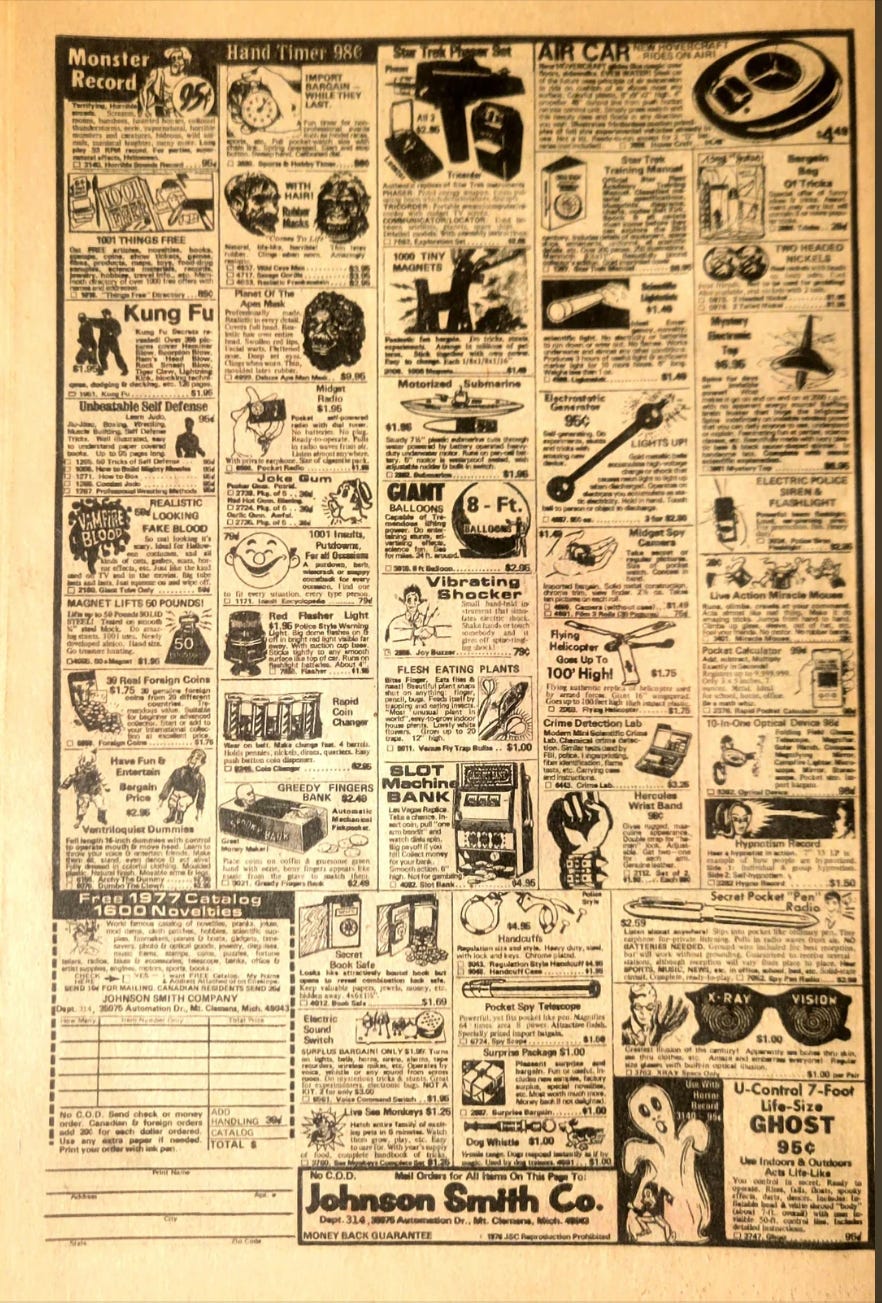
And then there was the back page.
Not just any page.
The page.
A dense grid of black-and-white ads promising miracles for a few dollars and a handwritten order form. X-ray glasses. Sea monkeys. Spy equipment. Magic tricks. Kung fu by mail. Each item offered just enough description to ignite the imagination and just enough illustration to make it feel plausible.
I never had the money to buy anything—“you have to save up,” my mom would say—but even if I had, how would I choose? The wanting was overwhelming. I wanted all of it. How do you pick one dream when they’re all equally compelling?
Every time I got a new comic, I skipped the story and went straight to the back. My eyes bounced around like I was solving a Where’s Waldo puzzle. So much possibility compressed into such a small space.
And then I saw it.
The magic carpet.
I stopped. Probably stopped breathing. There it was, in ink.
“Do you really think it can fly?” I asked my mom.
She explained—patiently—that rugs do not fly.
“But it says so right here,” I argued, pointing to the ad.
I mean… you can’t just print lies, right?
I decided my mother didn’t understand technology. Which was fair. She would later refer to the computer mouse exclusively as “the thing,” refusing to acknowledge its scientific name.
I was certain I was the smartest person in the room. I argued like a junior attorney, convinced that my parents’ lack of sophistication was the only thing standing between me and greatness.
Our kitchen seemed to confirm this. We decorated it with plastic fruit and grapes made of glass, arranged on a small-scale tray that had never served anything real. I assumed other families had real fruit, but I couldn’t see the advantage. Real fruit goes bad. Ours stayed exactly as it was.
Even then, I was drawn to things that looked right without asking anything of you.
Still, I lost every argument.
But all that boldness and confidence in me never trumped the fact that I was just a kid. And even if I wasn’t right on most things, I wasn’t wrong about believing in them.
I never got the magic carpet, which is unfortunate, because I would have used it for so many things. Home before dark with a promise not to venture off the block. But between sunrise and sunset, the places I would go were limitless.
Eventually, I did order something within my budget. A magic trick. I saved my money. Got permission. Filled out the form. Found an envelope and a stamp.
Then I noticed the delivery time.
4–6 weeks.
Four. To. Six. Weeks.
It might as well have been a geological era. I remember thinking how unfair and torturous the waiting would be. I crossed off days on the calendar like someone stranded, counting time by marks on a cave wall.
When it finally arrived, the trick held my attention for a few hours before being exiled to the toy box, joining everything else that had once promised rescue.
That was it.
And now?
Now I open Amazon.
In front of me is an endless supply of just about anything. The imagining has already been done. Color photographs and videos show me exactly how other people live with the thing—from the unboxing to the amateur review. Strangers feel oddly intimate. A man named Kyle explains how this product changed his life, and while I’m skeptical, I’m also convinced when twenty-five thousand other people agree.
Click. Submit.
Hours later—hours—it’s on my porch.
Everything I could possibly want, and many things I didn’t know I needed, arrive faster than anticipation can form. And just like that magic trick, it glows briefly before dimming, blending into the background of my life. Another object folded into the scenery.
Spring is coming. Which means it’s time to sort through things. Declutter. Make space. Create breathing room from all the objects that have quietly accumulated—each one purchased with the promise of ease, improvement, or transformation.
The irony isn’t subtle. The very things meant to enrich life often crowd out the space where life actually happens.
There was a study once—the marshmallow test. A child is given a marshmallow and told that if they wait fifteen minutes without eating it, they’ll get two. For years, the takeaway was that delayed gratification predicted future success.
But I think the more interesting part was never the marshmallow or the success it was meant to predict.
It was the waiting. That very space of delay.
The sitting with desire. The imagining. The boredom that wasn’t really boredom at all, but a fertile, restless space where the mind wandered and learned how to entertain itself.
That was the good part.
The magic trick itself barely held my attention. The dream of it lasted weeks.
Somewhere along the way, we stopped trusting that part—the dreaming, the waiting, the unstructured time where interest had room to grow. Curiosity started to look inefficient. Play felt indulgent. Learning needed a purpose, a payoff, a credential, or at least a side hustle.
Creativity followed the same path. It became something you could admire from a distance, something done well by professionals. Artists. Designers. The lucky few who managed to turn it into a job. The rest of us learned to watch instead of make.
Which is how you end up believing that creativity lives somewhere else. In studios. At places like Pixar.
And curiosity, on its own, stops feeling like enough.
Today, our dreams have grown larger but thinner. Lottery jackpots. Lakefront homes. Cars that cost more than my first house did fifteen years ago. We chase them with the same intensity I once reserved for a flying rug.
Carpet dreams.
But objects have never performed those tasks well. When they fail, as they always do, we assume the answer is more. Faster. Better.
And yet we’re left heavier than before. Emotionally. Financially. Spiritually.
The adjacency lesson comes back around. Surround yourself with objects promising arrival, and you begin to organize your life around waiting for delivery. Our carpet dreams don’t just disappoint. They linger.
It’s strange what actually makes you grateful.
Not the big stuff.
Not the stuff at all.
It’s the moments where you’re absorbed. Not producing. Not arriving. Just caught up in something that holds your attention long enough for time to loosen its grip.
A story about arrival often comes back to me. It’s about Björn Borg, the Swedish tennis legend known for both his dominance and his restraint. After one of his major championship wins—after years of discipline, repetition, and sacrifice—Borg was asked what it felt like to finally win.
He said the feeling lasted about ten minutes.
Not the match. Not the applause. The feeling.
Ten minutes of triumph, followed by the quiet return to himself. To practice. To repetition. To the daily work that had always been there, long before the trophy and long after it was put away.
Which makes me think about how often we treat things the same way we treat victories.
We buy them as proof.
As punctuation marks.
As evidence that we’ve arrived somewhere meaningful.
And like wins, they glow briefly. Then they recede into the background of our lives, leaving us exactly where we were before—only now with more to store, maintain, and sort through.
If arrival only lasts ten minutes, then maybe it was never the point.
The dream.
The practice.
The waiting.
That’s where life seems to happen.
You've said so much not just with the words, but in the spaces in between, I had to go back and read this again. I remember hearing about the marshmallow experiment and like your take on it.
I've felt all of this for some time, and am still asking myself: what's the better alternative? I try to live minimally and carve my own path, but still fight and sometimes give in to that temptation and thought that the answer is "out there". Love this piece Victoria!