


If you’ve ever felt pulled between the life you have and the life you long for, this one is for you. It’s about caretaking, identity, midlife reinvention, and how writing can become an act of rebellion.
I didn’t mean to start writing about the life I wanted.
It just happened—slipped out in a message to an old friend, the kind you can tell the truth to without bracing for judgment. I told her I felt like I’d been living inside a decade-long midlife crisis, some volatile mix of grief, urgency, and that strange nesting instinct that kicks in right before something big breaks open.
My dad’s death cracked something in me—not in the falling-apart way, but in the wake-up-and-pay-attention way. Suddenly, I felt an almost physical pressure to get my whole life sorted out, as if clarity were a room I needed to clean before anyone came over. But the harder I tried to simplify, the more complicated everything became. I felt like someone trying to hold two different lives in one pair of hands: the life my family recognizes, and the life I can feel rising beneath it like a quiet rebellion.
It’s exhausting, trying to reinvent yourself while still maintaining the version everyone expects.
And that’s when it occurred to me:
Maybe I could start writing the life I want, even if I can’t live it yet.
Maybe writing could be the place where I’m finally allowed to steer.
The Weight of the Everyday
I watch friends glide into retirement or reinvention with something that looks suspiciously like freedom. Meanwhile, my “retirement plan” involves a 32-year-old daughter navigating the fragile terrain of mental health—psychotic breaks, resets, rebuilding—and a 13-year-old granddaughter entering adolescence with her own fresh set of challenges. It’s been a 30-year loop of What’s for dinner? Where are you going? Who needs what?
Motherhood, grandmotherhood, caretaking—whatever you call it—has a way of consuming the edges of your life until you can’t tell where you end and responsibility begins.
I grew up swearing I’d never have kids. Not because I didn’t love them, but because I understood what they cost. And yet here I am, hinged to two generations at once. It’s not regret. It’s reality. It’s the gravity I live under.
And gravity, as any writer knows, is what gives a story weight.
The Unlived Life
There is a life I want—quiet, spacious, creative, self-directed. A life with long mornings, solitude, a bike trail stretching out in front of me, a room filled with books and notebooks, and the sound of my own thoughts.
I don’t resent the life I have. But I can feel the unlived one hovering just to the left of it, like a parallel universe that never quite had the chance to solidify.
Writers have always worked from this place.
Joan Didion wrote to discover her own patterns. Cheryl Strayed wrote the version of herself she needed in order to survive. Mary Oliver slipped into the life she wanted one walk at a time. Anne Lamott wrote her way toward a center she could never quite reach in real life.
Most of us live two lives: the one we can’t escape and the one we secretly long for. Writing is the bridge between them.
Writing as Rebellion
People think journaling is gentle. It’s not. It’s a form of protest.
On the page, I’m not a caretaker. I’m not making endless meals, solving crises, or tracking moods like weather patterns. I’m not responsible for forecasting the next storm.
On the page, I get to inhabit a version of myself I barely have time to meet in real life—the thoughtful one, the intentional one, the woman who stops long enough to feel what she actually feels.
Writing is the only place where I get to choose.
In real life, I’m often reacting.
On the page, I’m creating.
And creation is freedom.
The Backseat Driver
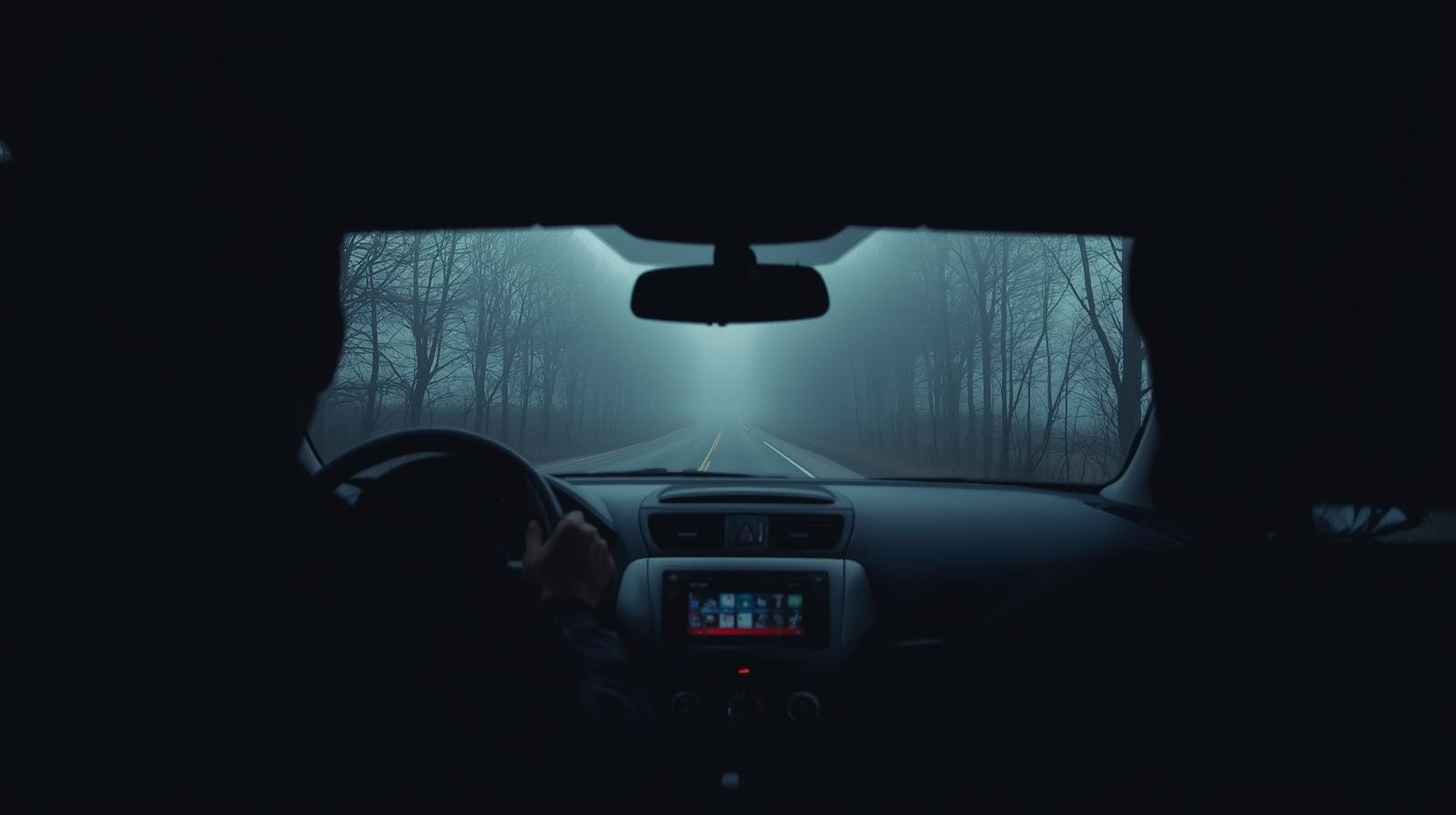
When I told my friend I felt like a backseat driver in my own life, I realized how deeply true that was. I’ve spent decades navigating from behind the front seat—offering direction, managing emergencies, keeping everyone moving—while the steering wheel remains just out of reach.
But writing lets me grab it, even if only in short, stolen bursts.
It’s the quiet revolution of a woman who has spent her whole life being needed: the decision to need something for herself.
And here’s the unexpected part: the more I write the life I want, the more I sense small pieces of it drifting toward me in real life. Not the full picture, but glimpses. A morning walk without interruption. A burst of clarity while washing dishes. A day that feels like it was actually mine.
The unlived life isn’t an escape. It’s a compass.
Every time I write, I’m asking myself: What would my life look like if I were the one choosing?
A Letter to the Other Women in the Backseat
If you’re reading this and recognizing something familiar in it, this part is for you:
You are allowed to want a life of your own.
You are allowed to long for solitude, for creativity, for purpose separate from the people who rely on you.
You are allowed to imagine the life you want, even if you can’t live it yet.
Writing it doesn’t make you selfish.
Writing it makes you honest.
Imagining the life you want isn’t disloyalty. It’s the first step toward becoming the person you were always meant to be—before obligation, circumstance, and survival rearranged the map.
We don’t have to escape our lives to reclaim them.
We have to start telling the truth about the parts we’ve postponed.
And sometimes the simplest truth of all is this:
We’ve been in the backseat long enough.
It’s time to write our way toward the wheel.
If this piece resonated with you, I’d love to hear from you.
What part of your life feels “unlived” right now?
Share your thoughts in the comments—I read every one.
Wow, this resonated so much. I always had the book 'Deep Work' on my TBR list. It sounded so idyllic, that's what I want to do. Then, when I finally read it, I could not read past the introduction since the author shares how he wrote it during a three-day retreat in a cabin in the woods. How privileged I thought, probably while his wife kept the fort back home if he had any children.
As a single mom, I had to work three jobs at some point (not counting motherhood) to make ends meet. Thinking and writing felt like a luxury I couldn't afford. I made peace with writing in the margins, but I love how it still adds up, and it is so true that writing is the bridge. I find it so therapeutic and lately the algorithm here on Substack has been generous to me, sending pieces to read that make me realise I was never as alone as I felt. And maybe I'll get my three days in a cabin one day, but for now, I'm okay to be a part of this quiet revolution where the caretakers are learning to prioritize themselves as well and write!
This resonates deeply.