


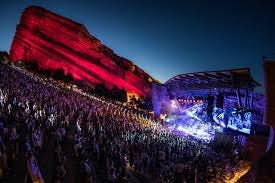
We stood at the top of Red Rocks Amphitheatre, my partner Pam, my adult daughter Emma, and my thirteen-year-old granddaughter Jaycee, staring down at what appeared to be approximately one hundred steps. In front of us, over nine thousand people who’d just seen Laufey perform were cheerfully descending into the darkness like they knew something we didn’t. Less than 15 minutes later, Jaycee was crying and shaking her head no.
This was after we’d spent roughly $1,000 on tickets. After we’d bought insurance on those tickets because there was a significant chance Jaycee wouldn’t be able to go, not because she didn’t want to, but because she has PDA, which sounds like a handheld device from 2003 but actually stands for Pathological Demand Avoidance. It’s recognized in Europe, not in the United States, because apparently, we’re behind on both healthcare and understanding why a child who desperately wants to do something will shut down completely when that thing becomes a “demand.”
Let me back up.
Three weeks earlier, Jaycee had done something unprecedented: she asked for something. “There is a concert I want to go to. Can we go?”
Jaycee is autistic with Tourette’s and PDA, which means she once asked for no Christmas presents at all, sending our relatives into philosophical tailspins. “What do you mean, no Christmas gifts?” they’d ask, as if she’d requested we cancel December. For the past six years, she’s shut down on everything from school to activities I was sure she’d love. So when she asked to see Laufey, I bought the tickets immediately, along with insurance, fully expecting we’d use the insurance.
The day of the concert arrived with its own dramatic timing. Just as I calculated we needed to leave, Jaycee announced she needed to lie down. We were late. Tragically late, as it turned out—we missed the opening act, whom my seatmate later informed me was “wonderful,” with the kind of emphasis that suggested I’d missed the Sermon on the Mount.
We wound up the mountain as the sun set, part of an endless caravan of headlights. We passed one full parking lot. Then another. Then another. I began to envision us parking in Wyoming. Eventually, we landed in South Lot 2, which felt like it could have been in Wyoming. A shuttle materialized—thank god—and deposited us at the top of the amphitheater, where we promptly descended those hundred steps to row nine.
Row nine, I should mention, was not a status symbol. It was what remained when your granddaughter asked to see a concert three weeks before the show.
The venue itself glowed under the moon, the Colorado red rocks lit like a cathedral. When Laufey took the stage, she spoke in a voice so quiet it seemed she might be confiding a secret. “Thank you for making my dreams come true,” she said. “You took time out of your day...paid money...to me.” She said this several times, and it landed as genuinely grateful rather than weird, which is a neat trick.
I was happy to make someone’s dreams come true, but mostly I was making Jaycee’s dream come true, which felt considerably more uncertain until she was actually there, sitting between us.
What surprised me was the crowd. I’d expected people my age—I’m pushing sixty—because this was jazz, or jazz-adjacent, with big band flourishes. Instead, the amphitheater was filled with teenagers wearing paper crowns and white go-go boots, dressed like they were heading to a fairy Renaissance faire. I felt ancient and underdressed.
Later, I asked Pam if she was surprised by how young everyone was. She’d read about Gen Z’s preference for simplicity. Calm. Quiet. “Oh,” I said, processing this. It made a strange kind of sense. These kids, having grown up with algorithmic chaos, were choosing Ella Fitzgerald’s great-great-granddaughter.
I felt a small thrill of vindication. My music was suddenly cool. Even though I didn’t know Laufey existed until three weeks ago.
The concert was brilliant. Jaycee clung to Pam’s arm, her legs bouncing steadily—a sign that she was pushing back against anxiety. She rarely smiles, but we could tell she was happy because she had actually stayed. The weather was perfect. The wooden benches were uncomfortable but communal. And then, in what felt like minutes, it was over.
“Do we go up or down to catch the shuttle?” Pam asked.
“Up,” I said confidently. “Back where we were dropped off.”
This was incorrect.
After climbing the steep incline—winded from a combination of altitude, stress, and poor planning—we rested against a railing and watched everyone else head down. There was no shuttle. I later learned the shuttle was not “a thing” after concerts. You simply walked down the mountain in the dark like our pioneer ancestors, except with cell phones.
Jaycee hit a wall. She’d used up her reserves—the concert itself, even happy, was overwhelming—and now faced a seventeen-minute walk down a steep mountain trail in the darkness. She was crying softly, shaking her head. She couldn’t do it. Not wouldn’t—couldn’t.
I didn’t know what to do. Uber was impossible, we were told, because of the exodus of cars. One guy was walking around with his phone displaying “CAR RIDE” in large letters. Still, we collectively agreed that getting into a stranger’s car at night on a mountain was where this heartwarming story would become a Dateline episode.
Then I spotted two large tour buses loading passengers below us. We made our way down—our last bit of momentum. I asked a woman directing traffic if the buses went to the south lot.
“No,” she said. “These are private buses going to Denver. You need to go back up to catch the shuttle.”
The shuttle that didn’t exist.
I told her someone had directed us here. Desperation was creeping in, making me chatty in that particular way that signals you’re about to lose it. Pam suggested one of us get the car and drive back. Emma pointed out, reasonably, that if Uber drivers couldn’t come up, why would we be allowed?
We stood there in the dark. Jaycee was shut down, unable to move. I was calculating and searching for the logic. What could we possibly do now to fix this?
Then the bus lady came back over. Her shift was ending in ten minutes. She offered to drive us to our car when she finished stacking cones.
“Yes!” I said. “Thank you so much!”
It was the kind of small mercy that makes you believe in people again. And as Pam reminded me later, to have faith in God answering prayers.
Will Jaycee remember this fondly? Did it add to her sense of calm and peace, or will it join the catalog of things that were too much? I don’t know.
I often tell Pam that a perfect life would be the two of us sitting quietly with good books—maybe camping, maybe on the back porch. There’s never any harm in that. The quiet solitude of adventure that captivates the mind while keeping the body safe.
Our little adventure wasn’t much of an adventure compared to most. There was no real risk to life or limb. But for us—well, maybe not for Pam, the only one without mental health struggles—it felt like standing on the edge—Jaycee, most of all, but also Emma and me. Our insecurities and fears aren’t figments. They’re real, even when they’re about something as simple as leaving a concert.
In the bus lady’s car, winding down the dark mountain road toward South Lot 2, Jaycee was silent. Not upset-silent. Just quiet. Pam held her hand. I looked out at the red rocks disappearing into the night, thinking about nine thousand people and one quiet girl who’d asked for something and actually received it. Two hours of near bliss where the rest of the world disappeared, and our hearts were lighter as we were serenaded by Laufey’s soothing voice and transported into a simpler, calmer time.
That was worth a thousand dollars and maybe even worth the climb.

Thank you for sharing 💕
Very well explained, and understood. Those are the experiences and memories you will always treasure even thought at the time, it may have been a little unnerving, to say the least! But reassurance of our God who is always there, never leaves us. Love you all! ❣️