


It’s the middle of summer, 2019. My granddaughter Jaycee is seven years old, crowned with a purple jester’s hat, her eyes masked in bat-shaped face paint. We’re at the Colorado Renaissance Festival—all turkey legs and kettle corn, fair maidens and men in tights. She’s holding a pickle we’re sharing, and as I snap the photo, she’s mid-laugh. Her eyes are wide with pure, unabashed joy. The pickle vendor leans into the frame at that exact moment. She never notices. She just keeps laughing.
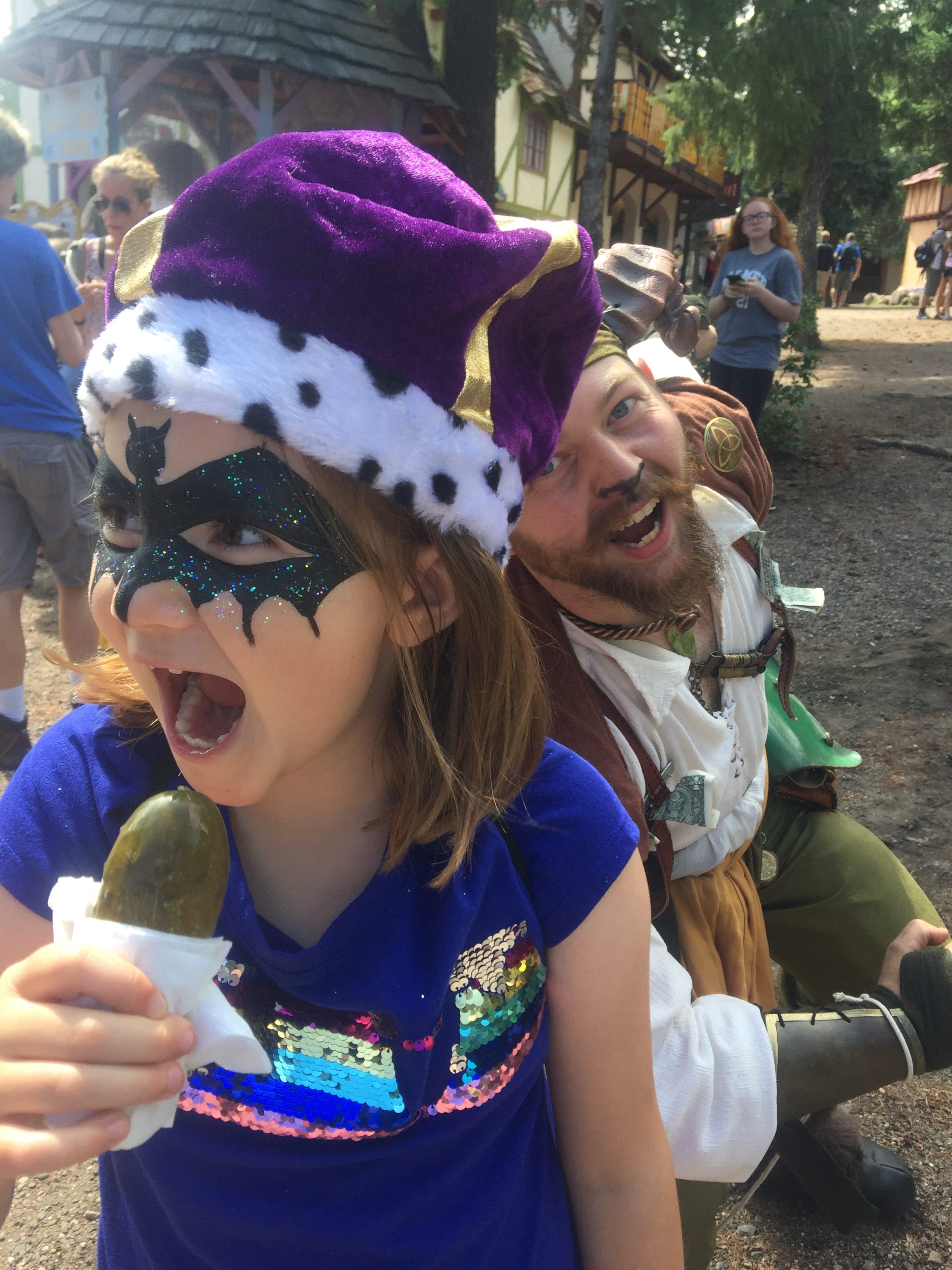
I didn’t know then that this moment would become holy. That I’d scroll through my phone years later and stop on this image. That I’d ache to crawl back inside it.
Within a year, we’d have words for what was happening inside her: high-functioning autism, anxiety, pathological demand avoidance, Tourette’s syndrome. The diagnoses explained everything and nothing. They told us what, but not how—how to reach her when she retreated into her closet, how to bring back her joy when the world became too loud, too demanding, too much.
Now she’s a teen. Quiet. Cautious. Reserved. She doesn’t laugh like that anymore. Her nervous system constantly sounds the alarm—every demand, even her own expectations, feels like a threat. The weight of the world has crept in, heavier for her than for most.
But here’s what I know: when I look at this photo, I can still hear that laugh ringing through the years like a bell. And more than that—I can feel who I was in that moment. The grandmother who bought the pickle. Who said yes to face paint and jester hats.
What I Thought I Knew
I thought photographs mattered because they captured moments. “A picture is worth a thousand words.” Click. Save. Done.
I was wrong.
When I look at that photo now, I feel something more complicated than nostalgia. There’s joy, yes. But there’s also a gutting regret—not just for the moment that’s gone, but for how asleep I was to it while it was happening. I thought the camera was doing the work of remembering for me. I didn’t write anything down. Not what it felt like to be fully present with her. Not the surge of gratitude I must have felt watching her pure, unguarded joy. Not the meaning of that moment—what it told me about love, about presence, about what matters most.
Now all I have is a feeling like a ghost haunting the edges of the frame. I can’t remember how it felt to be in that moment, experiencing it from the inside. My mind has rewritten the story to fit the meaning I need it to have today. And that’s the tragedy—without the words, without the story captured then, I’ve lost the truth of the moment. I only have the myth I’ve made of it since.
I thought I’d remember. I thought memory was a thing you could count on, like gravity.
In 2023, when my father died, I found drawers full of photographs. Faded prints curling at the edges. Men in fishing hats. Families gathered in kitchens I didn’t recognize. I didn’t know who most of them were. I didn’t know their stories.
There it was: evidence of a life, but not the life itself.
And here’s the thing that haunts me—I have the same drawers. My own camera roll full of images from decades ago that are already starting to blur—beautiful, empty shells. I’m becoming my father, forgetting my own story, and I didn’t even notice it happening.
What I Understand Now
We tell ourselves that photographs preserve memory. But what they actually do is reveal how much we’ve forgotten.
The real preservation—the real remembering—happens when we slow down enough to ask: What did this moment mean? Why did it matter? Who was I then, and who am I becoming?
This is why stories with photographs matter. Not because they document what was, but because they force us to live our lives twice. Once in real-time, moving fast, barely noticing. And then again, slowly, with attention—writing down what we felt, what we learned, what we’re still carrying.
That second living is where the meaning lives.
And it’s where the truth lives—captured before our minds rewrite the past to serve whatever we need it to mean today. Without the words written down in the moment, memory becomes mythology. We lose what actually happened and keep only the echo of how it felt—if even that—reshaped by every year that passes.
When I write about Jaycee’s laughter, the pickle, the sunlight slanting through the festival grounds, I’m not just writing to remember her. I’m remembering myself. The woman behind the camera who wanted to capture a moment but hadn’t yet learned that capturing and experiencing are two different things. That you can take a thousand pictures and still miss your own life.
There’s a cruelty in how ordinary the sacred looks while it’s happening. You never know which Tuesday afternoon will become the day you’d give anything to return to. Which laugh will be the last one that sounds like that? Which version of someone you love will be the one you ache for most?
The Truth About Regret
I could stay stuck here, spinning in the grief of what I didn’t write down, didn’t notice, didn’t save. God knows I’ve spent enough time in that particular hell.
But here’s what I’m learning: regret can be a teacher if you let it. The ache of what I didn’t capture in 2019 is teaching me to pay attention now. To write things down. To ask my granddaughter questions while she’s still willing to answer them. To notice not just what’s in front of me, but what I’m feeling about what’s in front of me.
The stories I write now aren’t just about the past. They’re about who I want to be going forward. They’re about breaking the pattern of sleepwalking through my own precious life.
Because here’s the thing about patterns: they repeat until you see them clearly enough to choose something different.
What Stories Do
When I look at that photograph now and write about it, something shifts. The image stops being just a record of what was and becomes a mirror. I see Jaycee’s radiance, yes. But I also see my own capacity for presence. My own ability to create moments of magic, even imperfectly.
Maybe that’s the real work of storytelling—and the real work of love. To hold up the mirror. To say: This happened. This mattered. This is who we were when we were fully awake, fully alive. This is evidence of our brightness, even when—especially when—we can’t see it ourselves.
Jaycee is older now. Her laughter is different—quieter, more private, harder won. The world is teaching her to guard her joy, to trade her sparkle for armor. I understand that. I did the same thing. We all do.
But when I show her this photograph, when I read her the story of that day, I’m offering her something more valuable than nostalgia. I’m offering her evidence. Proof that joy isn’t lost—it’s just buried, waiting to be called back into the light. That the girl with the bat-painted face and the pickle in her hand is still in there, even when the world makes it hard to remember.
And maybe, if I’m lucky, these stories will do the same for her that writing them does for me. Maybe they’ll help her see that memory isn’t meant to be a museum—something dead and preserved behind glass. Memory is a map. It shows us where we’ve been, so we can understand where we’re going. It shows us what brought us joy so we can create more of it. It shows us who we were, so we can remember who we want to become.
The Way Forward
The photograph of Jaycee at the Renaissance Festival will never change. She’ll always be seven. The pickle vendor will always be leaning into the frame. Her laugh will always be mid-flight, caught in that split second before it fades into the air.
But writing about it now—even with the truth already slipping into mythology—creates something new. Understanding. Not just about what I lost, but about what mattered. Who I was in that moment. What brought us joy.
That’s what storytelling is for. Not to freeze the past perfectly, but to capture the truest sense of ourselves while we can—and then to use that truth as a map. To understand where joy lives so we can create more of it. To transform regrets into direction. To save ourselves from repeating the forgetting.
Because the alternative is drawers full of photographs of strangers who used to be the people you loved, and that is too much to bear.
That's a beautiful photo! This resonates as I think of my teen when she was little and carefree. I wish they could hold on to the pure unselfconscious joy.
https://open.substack.com/pub/debbierainer/p/words-or-pictures?r=5i5139&utm_medium=ios